The Myth of Arachne and a poem by A.E. Stallings, "Arachne gives thanks to Athena".
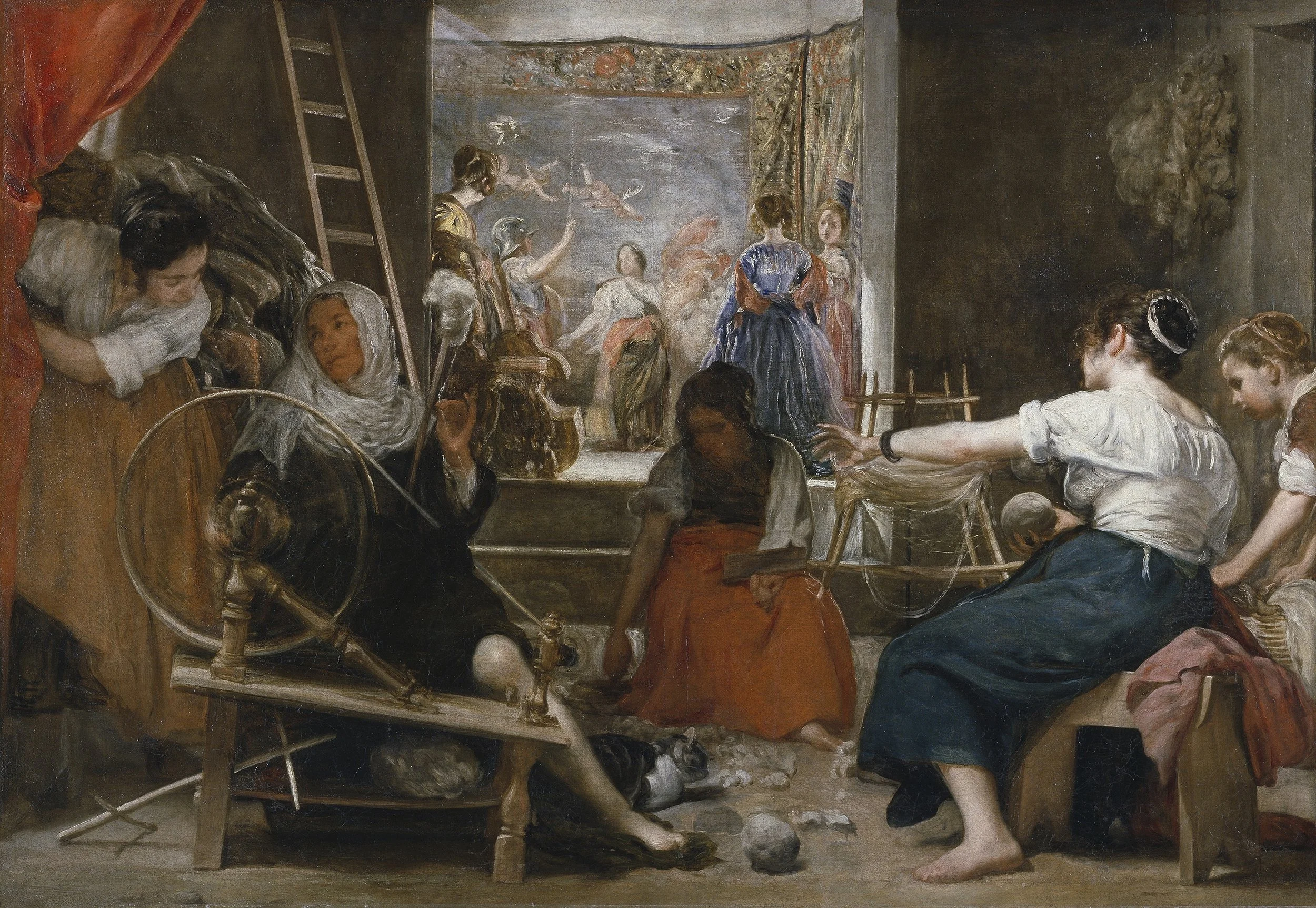
Diego Velázques, Las Hilanderas (The Fable of Arachne), 1657, oil on canvas
The Myth of Arachne
ARACHNE (Arakhnê), a Lydian maiden, daughter of Idmon of Colophon, who was a famous dyer in purple. His daughter was greatly skilled in the art of weaving, and, proud of her talent, she even ventured to challenge Athena to compete with her. Arachne produced a piece of cloth in which the amours of the gods were woven, and as Athena could find no fault with it, she tore the work to pieces, and Arachne in despair hung herself. The goddess loosened the rope and saved her life, but the rope was changed into a cobweb and Arachne herself into a spider (arachnê), the animal most odious to Athena. (Ov. Met. vi. 1-145; Virg. Georg. iv. 246.) This fable seems to suggest the idea that man learnt the art of weaving from the spider, and that it was invented in Lydia.
Source: Dictionary of Greek and Roman Biography and Mythology.
"Arachne gives thanks to Athena", AE Stallings, 1999.
It is no punishment. They are mistaken –
The brothers, the father. My prayers were answered.
I was all fingertips. Nothing was perfect:
What I had woven, the moths will have eaten;
At the end of my rope was a noose's knot.
Now it's no longer the thing, but the pattern,
And that will endure, even though webs be broken.
I, if not beautiful, am beauty's maker.
Old age cannot rob me, nor cowardly lovers.
The moon once pulled blood from me. Now I pull silver.
Here are the lines I pulled from my own belly –
Hang them with rainbows, ice, dewdrops, darkness.
A.E. Stallings (current Oxford Professor of Poetry)
sourced from https://reverberatehills.blogspot.com/2013/08/poem-of-week-201333.html